Designing a Polynesian Sleeve
A Polynesian sleeve is one of the most complex and visually striking forms of body art. Unlike Western sleeve tattoos that often combine unrelated images, a Polynesian sleeve is a unified composition — a single, cohesive design that wraps the arm from shoulder to wrist (or any segment in between) with interconnected patterns and symbols.
At IslandTAT, every sleeve is designed freehand directly on the body. This means there are no stencils, no pre-printed templates — Joshawa Elsas draws each design by hand, following the natural contours of the client's arm, shoulder, and musculature. The result is a sleeve that looks and feels like it belongs to the wearer because it was literally built on their body.
The process of designing a Polynesian sleeve is fundamentally different from how most tattoo studios approach the work. Rather than printing a flat design and wrapping it around the arm, your artist treats the arm as a three-dimensional canvas — a living sculpture that changes shape with every movement. This approach produces results that are impossible to achieve with conventional methods.
Sleeve Structure: The Zones
A Polynesian sleeve is built around a structured body map. Anatomically, each zone of the arm behaves differently — the deltoid curves, the bicep transitions, the elbow bends, the forearm tapers and rotates — and the composition is planned zone by zone around that. At IslandTAT we also use each zone to carry a different part of the wearer's story; that pairing is our working framework, not a fixed cultural rule.
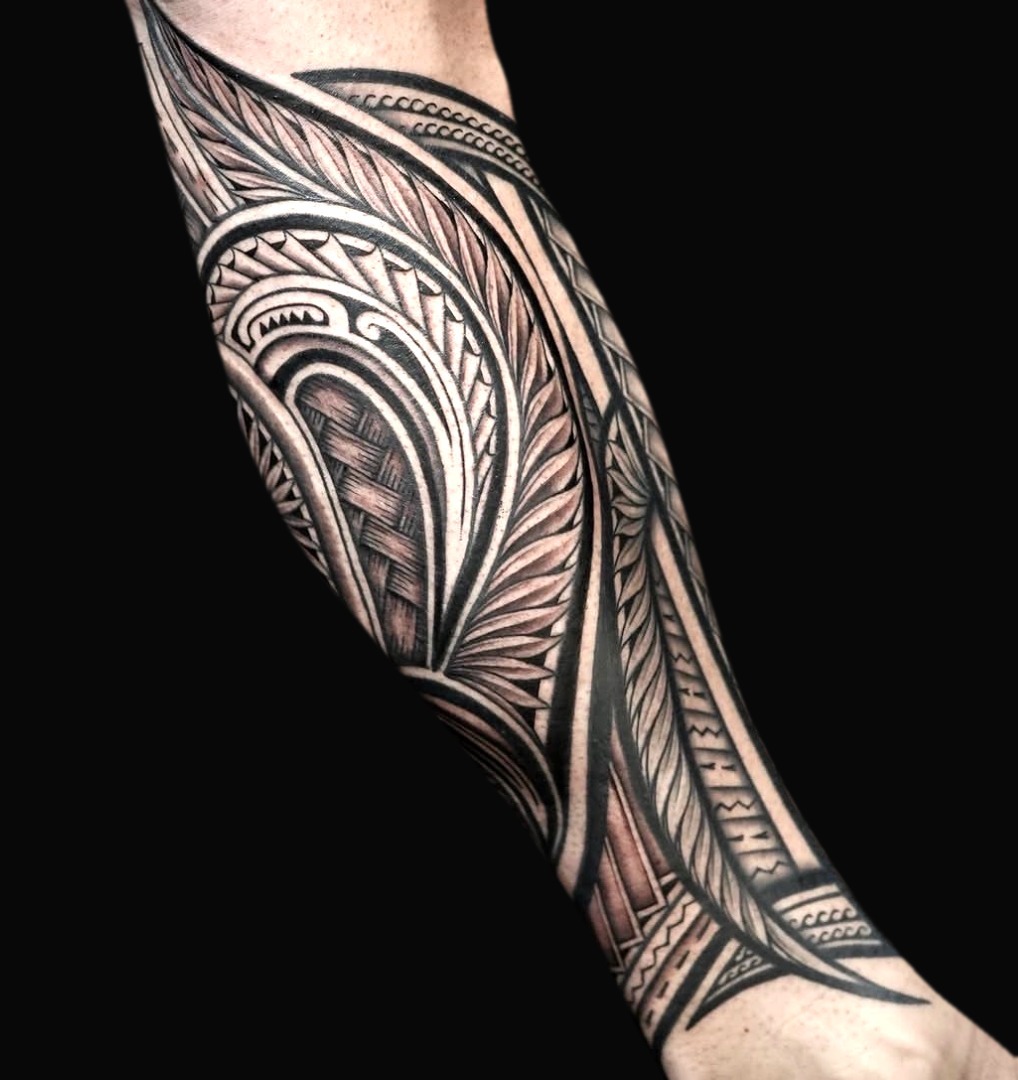
Shoulder & Upper Arm
Represents strength, bravery, and status. The rounded contour of the shoulder allows for bold, dynamic compositions. This is often where the most prominent symbols are placed — sun motifs, tiki guardians, and large-scale patterns that establish the visual hierarchy of the entire sleeve.
The shoulder cap is a critical design element because it establishes the visual tone for the entire composition. A bold, dense shoulder piece sets the expectation for a powerful, commanding sleeve. A more open, airy shoulder design creates a foundation for a refined, detailed sleeve that reveals its complexity gradually. At IslandTAT, the shoulder design is always developed first, as it anchors everything that follows.
Mid-Arm & Bicep
A transitional zone that often features connecting patterns, bands, and secondary motifs. The curvature of the bicep creates natural opportunities for wrapping designs that reveal different elements from different angles — a front view might show warrior symbols while the inner arm reveals family motifs.
The mid-arm is where the compositional skill of the artist is most evident. This zone must seamlessly connect the bold shoulder work above to the more intricate forearm work below. The transition should feel natural and inevitable — as if the patterns are flowing down the arm like water, gaining detail and refinement as they progress.
Forearm
Traditionally represents creativity, craftsmanship, and action — what you do with your hands. Forearm designs often feature more intricate, detailed work with smaller-scale patterns that complement the bolder compositions above. The forearm is the most visible part of the sleeve in daily life, making it a showcase zone where fine detail work can be fully appreciated.
The forearm presents unique design challenges due to its tapered shape — wide near the elbow and narrower at the wrist. Skilled freehand design accounts for this taper, using it to create natural compositional flow. Patterns can widen as they ascend toward the elbow or converge as they descend toward the wrist, creating a sense of visual rhythm that echoes the arm's natural geometry.
Wrist & Hand
The final point of the composition, where the design comes to a natural conclusion. Wrist elements often feature fine banding, closing motifs, or patterns that taper elegantly. The wrist closure is one of the most important design decisions in a Polynesian sleeve — it determines how the composition ends and how it interacts with the wearer's hand.
Some clients choose to extend their sleeve into the hand, creating a continuous flow from shoulder to fingertips. Others prefer a clean wrist termination that allows the sleeve to exist as a self-contained unit. Both approaches are valid in Polynesian tradition, and the choice depends on the client's lifestyle, professional considerations, and personal aesthetic preferences.
Types of Polynesian Sleeves
Full Sleeve
Extends from shoulder to wrist, covering the entire arm in a unified composition. A full Polynesian sleeve is a major commitment, built over several sessions; the tattoo time depends on your artist, coverage, and design detail. The freehand design process adds additional time, as your artist draws and refines the composition on the body before tattooing begins. The result is the most comprehensive and visually impactful form of Polynesian arm tattoo.
Half Sleeve
Covers either the upper arm (shoulder to elbow) or the lower arm (elbow to wrist). Half sleeves are popular because they offer significant visual impact while remaining easier to conceal when needed. The upper half sleeve, anchored by the shoulder cap, is the most common starting point for clients who may eventually extend to a full sleeve.
Three-Quarter Sleeve
Extends from the shoulder to mid-forearm, stopping before the wrist. This length allows for extensive storytelling while maintaining a clean termination point. Three-quarter sleeves are increasingly popular among clients who want substantial coverage with a defined endpoint.
Body Flow: The IslandTAT Difference
The concept of "body flow" is central to IslandTAT's approach. This means every line, every curve, every transition in the design follows the natural movement of the body. When the arm flexes, the tattoo moves with it. When the arm is at rest, the composition sits harmoniously.
This is why the work is drawn freehand. A human arm is a three-dimensional, moving form, and freehand design allows the artist to respond in real time to the client's anatomy — adjusting pattern scale, direction, spacing and transitions as the design wraps.
Body flow encompasses several technical considerations that your artist accounts for during the design process. Muscle definition affects how patterns sit — a design that looks perfect on a relaxed arm must also work when the bicep is flexed. Joint movement creates creasing zones where intricate detail would be lost — these areas require different pattern approaches. The inner arm presents different skin texture and stretching characteristics than the outer arm, requiring adjusted line weights and spacing.
Every body is different, and freehand design celebrates that individuality. Two clients requesting the same symbolic content will receive entirely different compositions because their bodies are different. This is the essence of well-composed Polynesian tattooing — the design is inseparable from the body it adorns.
The Consultation & Design Process
Creating a Polynesian sleeve at IslandTAT begins with an in-depth consultation. Your artist discusses the client's story, heritage, values, and aesthetic preferences. He identifies the symbols that will form the narrative foundation of the design and maps out the compositional structure across the arm's zones.
On the day of the session, your artist draws the design directly on the client's arm using skin-safe markers. This freehand process typically takes 1 to 3 hours for a full sleeve layout, during which the client can observe the composition taking shape and provide feedback in real time. Once both artist and client are satisfied with the design, tattooing begins.
This collaborative, freehand approach is what separates IslandTAT's sleeve work from studios that rely on pre-made templates. The result is a sleeve that is uniquely yours — designed for your body, built around your story, and executed with the precision that only specialized experience since 1999 can deliver.
Explore placement meaning to understand how body zone selection influences your design, or learn about the symbols that fill each zone. View our portfolio to see sleeve work in action, or visit the Polynesian Tattoo San Diego pillar page for a comprehensive overview.
Continue Reading
Locations We Serve
Nearby areas with their own project notes and travel details: