Quick Answer
What is a Polynesian tattoo?
A Polynesian tattoo is a structured composition of geometric motifs from the Polynesian Triangle — Samoa, Hawaiʻi, Tonga, the Marquesas, Tahiti, and Aotearoa (Māori) — often associated with genealogy, protection and personal story. Language, protocol and meaning vary by island culture, lineage and practitioner. At IslandTAT in San Diego, every Polynesian tattoo is designed freehand, drawn directly on the body so the composition flows with your anatomy.
Written by Joshawa Elsas
Founder, IslandTAT · Practicing tattoo since 1999
Last reviewed: September 13, 2026
Polynesian Tattoo
A Polynesian tattoo is more than tribal artwork on skin — it is a structured language of motifs, flow, and meaning that traces back more than two thousand years across the Pacific Islands. At IslandTAT in San Diego, the Polynesian tattoo is our entire craft.
This is a research-led Polynesian tattoo resource — what it is, where it comes from, how documented motifs are understood and used across different traditions, how the regional styles differ, how a sleeve is composed, what the process looks like from consultation to healed final piece, and how to start your own project with the right artist.
What Is a Polynesian Tattoo?
A Polynesian tattoo is a body composition built from geometric tribal motifs rooted in the cultures of the Polynesian Triangle — Samoa, Hawaiʻi, Tonga, Aotearoa (New Zealand / Māori), the Marquesas, Tahiti, and the surrounding Pacific Islands. Unlike Western tattoo styles that often center on a single image, a well-composed Polynesian tattoo is a full composition. Patterns interlock, motifs nest inside one another, and every section of the design flows into the next.
The English word tattoo itself comes from the Polynesian word tatau, recorded in Tahitian and Samoan by Captain Cook's crew in 1769. For more than two thousand years before that, Polynesian peoples used hand-tapped bone combs and natural pigment to mark genealogy, status, protection, and rite of passage directly into the skin. The Polynesian tattoo was never decoration — it was identity.
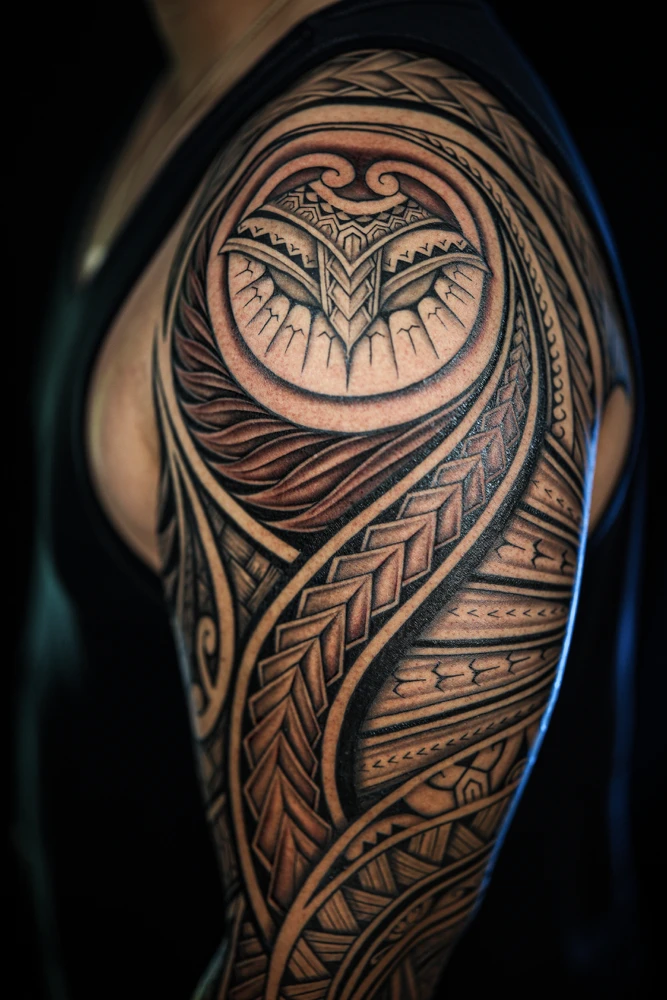
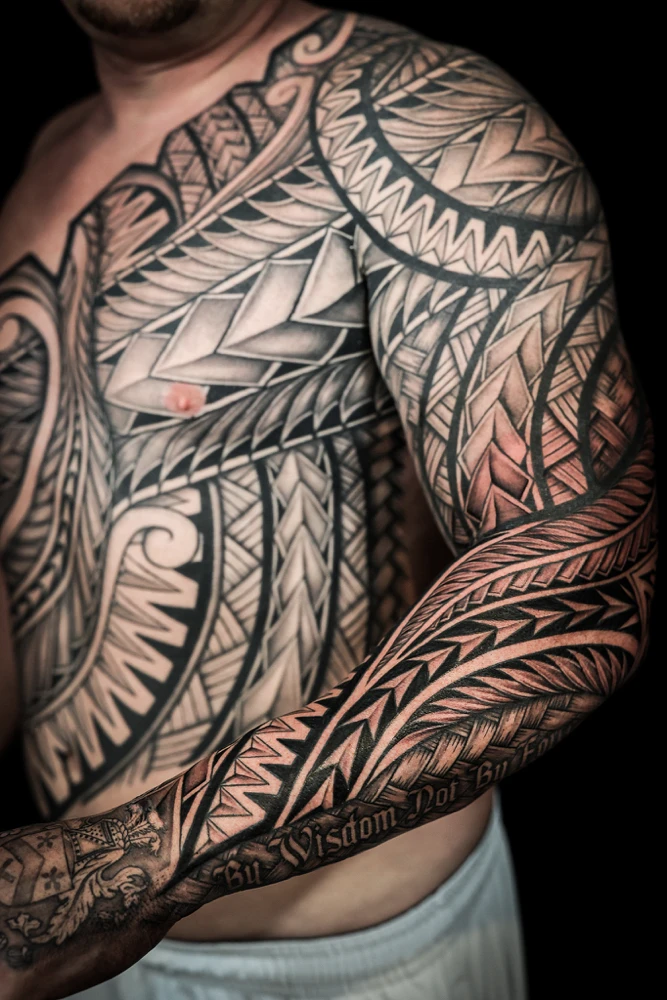
Polynesian tattoos are composed to follow the body's natural anatomy. A sleeve wraps around the arm in a way that reads cleanly from every angle. A chest panel respects the symmetry of the pectoral muscles. A leg piece tapers with the calf and builds mass with the thigh. This is why IslandTAT designs every Polynesian tattoo freehand — see the IslandTAT Method for the full design philosophy.
Polynesian Tattoo Meaning
Polynesian tattooing works from a vocabulary of recurring motifs — shark teeth, enata, ocean waves, spearheads, turtles, manta rays, koru spirals — combined into compositions that narrate heritage, family and journey. What each one means is not fixed by the shape: some readings are documented within a single named tradition, some are common modern associations, and some are decided with the wearer. A motif does not earn a universal definition because a similar shape appears in more than one culture.
Meaning lives at three levels in every Polynesian tattoo: motif (the individual symbol), arrangement (which motifs sit beside which, and in what flow), and placement (where on the body the composition lives). A shark tooth on the shoulder reads differently than the same motif worn at the wrist. A row of enata wrapping the forearm communicates ancestry; the same row across the chest is closer to identity.
Read the full breakdown on our Polynesian tattoo meaning and Polynesian tattoo motifs guides. If you want to work through an existing piece element by element, see how to read a Polynesian tattoo, and for why the same motif shifts meaning between islands, read how Polynesian tattoo symbolism works. Longer research and source material lives in the Polynesian tattoo knowledge hub.
Core Polynesian Tattoo Motifs at a Glance
- Niho Mano (Shark Teeth) — protection, strength.
- Enata — people, ancestors, lineage.
- Ocean Waves — life, change, journey.
- Turtle (Honu) — longevity, family, navigation.
- Manta Ray — grace, freedom, guidance.
- Koru (Spiral) — new life and growth (Māori).
- Spearhead — courage and warrior spirit.
- Fish Hook (Makau) — prosperity and safe passage.
Polynesian Tattoo Motif Glossary
| Motif | Meaning |
|---|---|
| Niho Mano (Shark Teeth) | Protection, strength, ferocity, adaptability. |
| Enata | People, ancestors, family lineage. |
| Ocean Waves | Life, change, journey, continuity. |
| Spearhead | Courage, warrior spirit, defense. |
| Turtle (Honu) | Longevity, family, navigation, peace. |
| Manta Ray | Grace, freedom, wisdom, guidance. |
| Koru (Spiral) | New life, growth, harmony — central to Māori work. |
| Tiki | Ancestor figures, spiritual protection (used with care). |
| Sun Rays | Eternity, leadership, brilliance. |
| Lizard / Gecko | Communication with gods, supernatural awareness. |
| Fish Hook (Makau) | Prosperity, abundance, safe passage on water. |
| Centipede | Power, danger, warrior energy. |
| Stars | Navigation, guidance, destiny. |
| Crosses / Marquesan Cross | Commonly read as balance; the four-element reading is modern, not a documented Marquesan definition. |
Polynesian Tattoo vs Tribal Tattoo
"Tribal tattoo" is a broad umbrella term the Western tattoo industry adopted in the 1990s to describe any black-ink, geometric, indigenous-influenced design. Under that umbrella sit dozens of unrelated traditions — Borneo Iban, Filipino batok, Native American bands, Celtic knotwork, and Polynesian. A generic "tribal" tattoo often blends these vocabularies together, prints them from a flash sheet, and applies them the same way to any body.
A Polynesian tattoo is different. It is a specific design language with its own grammar, its own regional dialects, and its own rules about which motifs pair with which, where they sit on the body, and what each combination communicates. A Polynesian tattoo done properly is never a flash-sheet decal — it is a custom composition drawn for one specific person on one specific body.
The practical differences show up on the skin. A generic tribal design tends toward tapering flames, sharp arrow points, and Y-shaped closed loops with no cultural anchor. A Polynesian composition uses named, meaningful motifs — niho mano, enata, koru, spearheads, waves — arranged into zones that follow anatomy. You can point to any square inch of a culturally grounded Polynesian tattoo and name what is in it, why it is there, and what it means for the person wearing it.
For a full side-by-side breakdown, see our Polynesian vs tribal tattoo comparison, or explore the broader tribal tattoo and tribal tattoo meaning pillars.
Regional Polynesian Tattoo Styles
Polynesian tattoo is not a single style. It is a family of related traditions, each with its own visual grammar, ritual practice, and cultural meaning. Modern Polynesian work at IslandTAT draws thoughtfully from each tradition while always remaining respectful of which marks belong to which culture.
- Samoan (tatau) — dense, geometric, deeply ritual; the pe'a and malu.
- Māori (tā moko) — flowing spirals (koru) and curvilinear genealogy marks.
- Marquesan — the densest panel-rich, highly geometric tradition.
- Hawaiian (kakau) — black, geometric, lineage- and protection-based.
- Tahitian — bold silhouettes, strong negative space; origin of the word "tattoo".
Samoan Tattoo (Tatau)
Samoan tatau is the deepest unbroken Polynesian tattoo lineage still practiced today. The pe'a (male thigh-to-knee composition) and malu (female knee-to-upper-thigh composition) are profound rites of passage applied by hand-tapped au tools over multiple days. Modern Samoan-style tattooing in a contemporary studio honors the geometric density, symmetry, and bold black work without replicating the ritual marks reserved for Samoan people.
Māori Tattoo (Tā Moko)
Tā moko is the Māori tradition of Aotearoa (New Zealand). Traditionally chiseled into the skin rather than punctured, tā moko uses flowing spirals (koru) and curvilinear patterns to communicate genealogy, tribe, and personal mana. The facial moko (moko kauaefor women, full-face mataora for men) is reserved for Māori. Māori-inspired motifs can be respectfully incorporated into a contemporary Polynesian composition outside that cultural boundary.
Marquesan Tattoo
Marquesan work is the densest in Polynesia — the historical full-body Marquesan composition left almost no untouched skin. Marquesan motifs (etua, ipu, the Marquesan cross) form the structural backbone of much modern Polynesian sleeve design. If you want a dense, panel-rich, highly geometric Polynesian sleeve, the Marquesan tradition is its visual foundation.
Hawaiian Tattoo (Kakau)
Kakau is the Hawaiian tradition — black, geometric, lineage-based. Traditional kakau centered on family origin, place, and spiritual protection (aumakua). Common Hawaiian motifs include shark teeth (niho mano), waves, and the eight-pointed star. Hawaiian influence shapes much of IslandTAT's work given Joshawa Elsas's upbringing on Oahu.
Tahitian Tattoo
Tahitian is the modern face of Polynesian tattoo for many people — bold black silhouettes, strong negative-space compositions, and dramatic motif scale. The word tattoo itself traces to the Tahitian tatau. Contemporary Tahitian-style work is the most flexible modern dialect of Polynesian tattoo and adapts beautifully into custom IslandTAT sleeves.
For deeper reading, explore our guides on Polynesian tattoo styles and Polynesian tattoo history.
Choosing the Right Motifs for Your Story
A Polynesian tattoo is only as strong as the motifs inside it — and the motifs are only as strong as the reasoning behind them. Clients often arrive with a favorite symbol in mind (usually shark teeth, waves, or a turtle) and assume the rest of the composition will fall into place. In practice, the strongest Polynesian tattoos are built the other way around: we start with your life, then choose the motif vocabulary that carries it.
During consultation, Joshawa walks through four story anchors with every client: where you come from (family, ancestry, place), what protects you (people, principles, faith), what you have overcome (loss, survival, change), and where you are going (journey, calling, family you are building). Each anchor maps to specific motifs — enata for lineage, shark teeth for protection, waves for change, spearheads for courage, fish hooks for prosperity and safe passage.
Motif combinations matter as much as the motifs themselves. A row of enata standing beside shark teeth reads as "family that protects." A koru spiral wrapped by waves reads as "growth through change." A turtle framed by a Marquesan cross can be read, in IslandTAT's interpretation, as "long life held in balance." The composition is a sentence, not a word list.
We also actively discuss what not to include. Some marks are culturally reserved — the Samoan pe'a and malu, the Māori facial moko, certain lineage-specific Hawaiian marks — and are never applied outside their proper cultural context. Others (like Tiki figures) are used with care and only when they genuinely fit your story. This filtering is a core part of what makes an IslandTAT Polynesian tattoo different from a generic tribal design.
Explore individual motif deep dives: shark teeth (niho mano), enata, ocean waves, turtle (honu), manta ray, spearhead, and fish hook (makau).
Polynesian Tattoo Sleeves
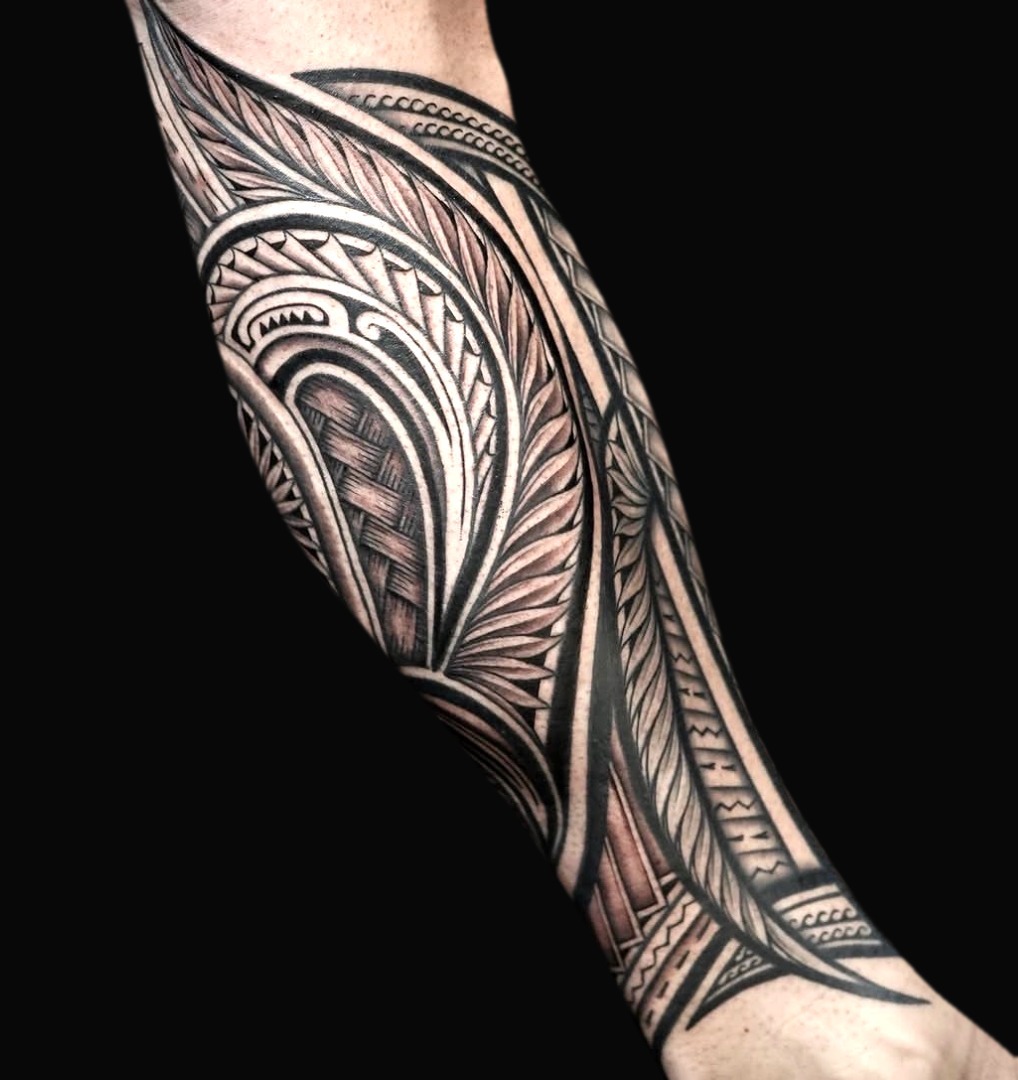
The Polynesian sleeve is the most requested project at IslandTAT. A full Polynesian sleeve wraps the entire arm from shoulder to wrist with a single, flowing composition built from interlocking motifs. A half sleeve covers either the upper or lower arm.
IslandTAT divides the sleeve into five zones — shoulder cap, upper arm, elbow, forearm, and wrist — each given its own motif role inside the overall flow. This zoning is what makes a Polynesian sleeve read as one coherent composition rather than a stack of separate tattoos.
Sleeve research: Polynesian sleeve tattoos, sleeve design guide, sleeve planning, leg sleeves.
Polynesian Tattoo Placement
Where you place a Polynesian tattoo matters as much as the design itself. Different body areas carry different cultural weight, different visual scale, and different healing demands. Common placements at IslandTAT:
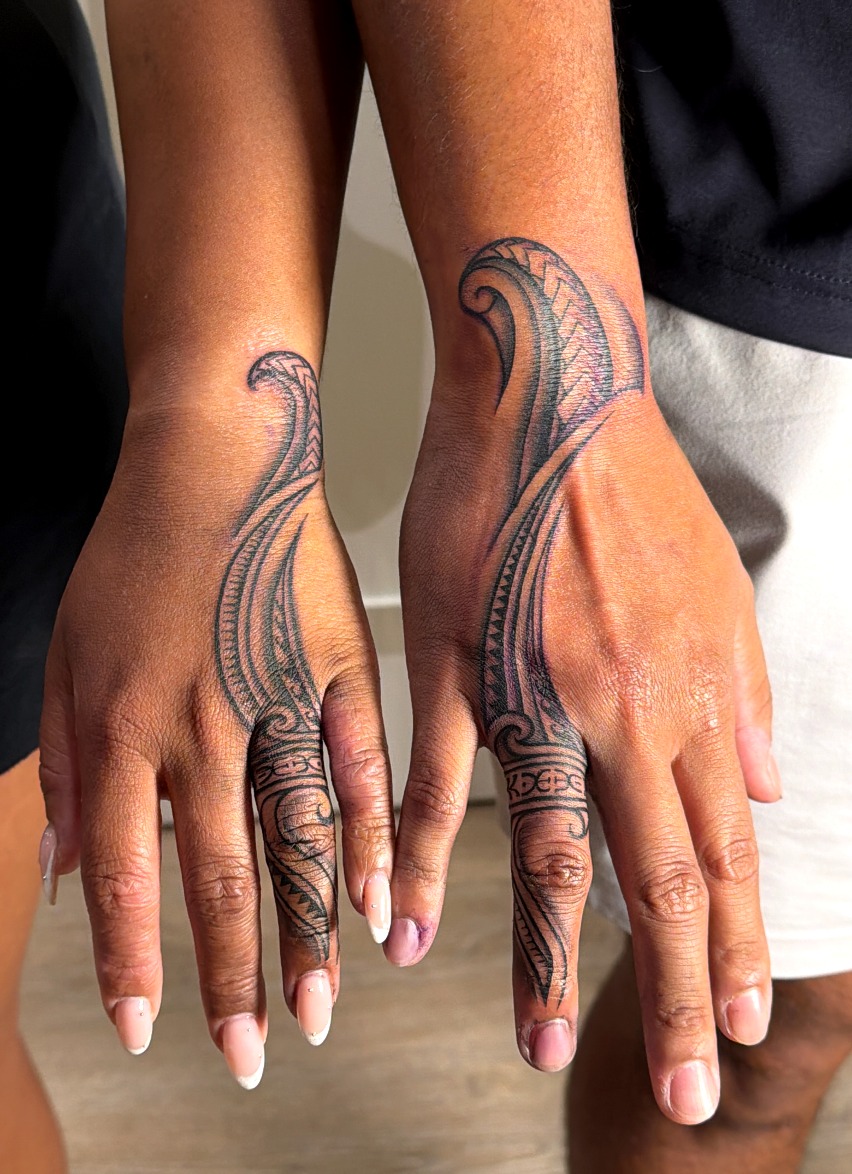
- Polynesian arm tattoos — sleeves, half sleeves, forearm bands, shoulder caps.
- Polynesian chest tattoos — pectoral panels, sternum work, chest-to-shoulder extensions.
- Polynesian back tattoos — full back pieces, shoulder blade compositions, spine-led designs.
- Polynesian leg compositions — calf wraps, thigh pieces, full leg sleeves, knee-to-ankle bands.
- Ribs, hip, and side panel work — generally undertaken once a client has prior tattoo experience.
For a full breakdown of how each placement reads visually and culturally, see our Polynesian tattoo placement guide.
The Polynesian Tattoo Process
Every Polynesian tattoo at IslandTAT moves through six stages. The process is designed so the final piece carries real meaning — not just visual impact.
- Consultation — a deep conversation about your story, heritage, family, influences, and the meaning you want the piece to carry. Read more.
- Motif & zone planning — the artist maps which motifs go where on your body and what role each zone plays in the composition.
- Freehand drawing — the design is drawn directly on your skin in marker. You see the full composition before any needle work begins.
- Session work — the tattoo is applied across multiple sessions, with healing time between.
- Healing — 2–3 weeks between sessions for proper skin recovery. See aftercare.
- Final pass — refinement, detail work, and a final balance check across the whole composition.
The full philosophy lives in The IslandTAT Method. For preparation guidance, read Preparing for Your Tattoo and What to Expect During Your Session.
Why Freehand Polynesian Tattoos Matter
Stencils are a legitimate professional tattooing method, and most Polynesian designs are applied that way. IslandTAT works differently because large-scale Polynesian composition has to resolve around a curved, moving body.
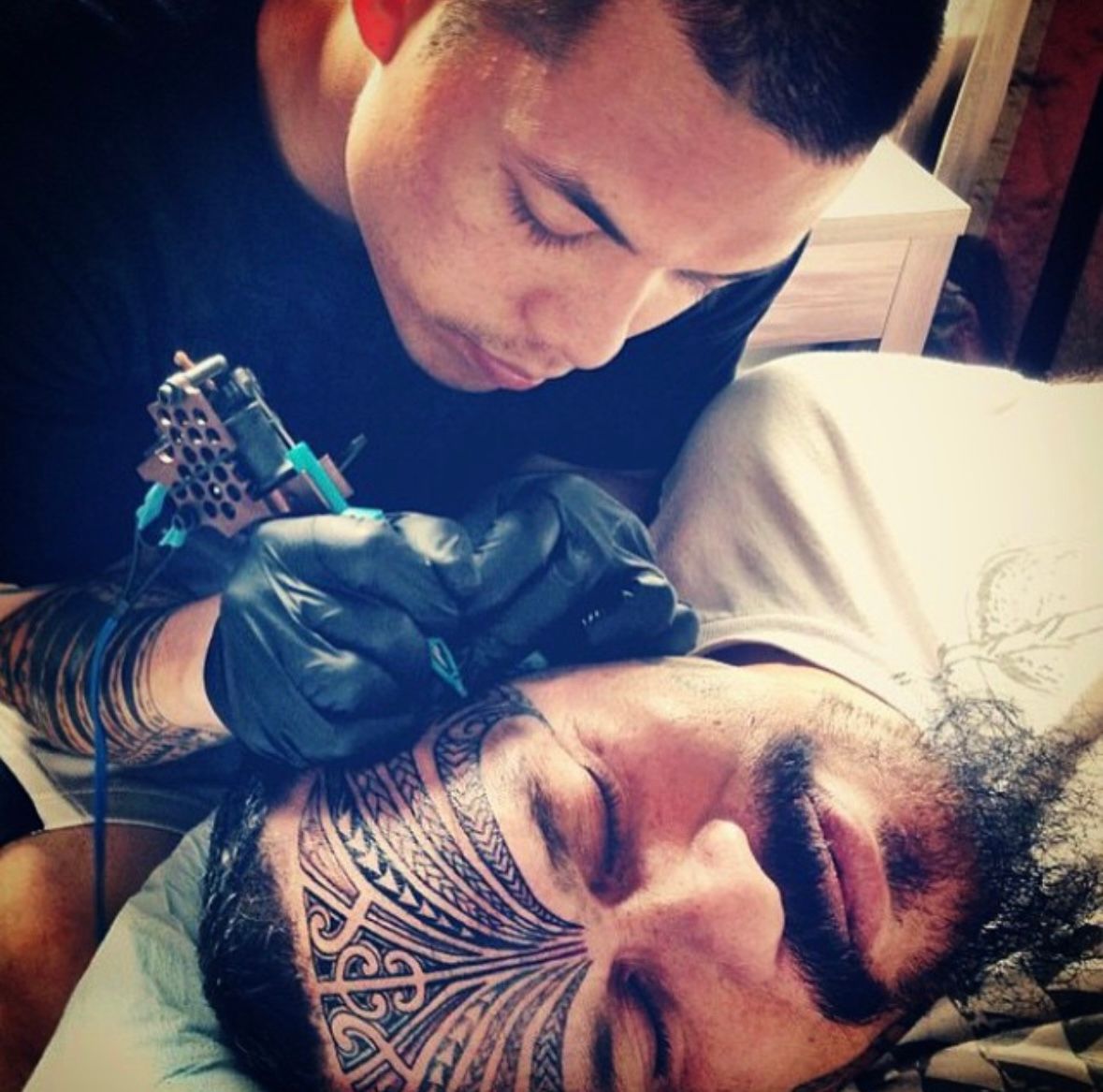
Every Polynesian tattoo here is drawn directly on the body so the composition responds to your anatomy in real time — your deltoid, your bicep insertion, the curve of your forearm. This is the core difference between a tribal-looking tattoo and a structured Polynesian composition.
Read more on freehand Polynesian tattoo and why freehand matters.
Cultural Respect & Etiquette
A Polynesian tattoo is a cultural artifact worn on your body for the rest of your life. Treating it with respect is not an optional extra — it is what separates a meaningful piece from a costume. IslandTAT's approach is built on three principles: honor the source, personalize the story, and never appropriate closed marks.
Honor the source. Every motif we use has a name, a region of origin, and a documented meaning. During consultation we tell you which culture each motif comes from and why we are proposing it for your composition. Clients leave the consultation able to explain, in their own words, what is on their body and why.
Personalize the story. You should never wear someone else's identity. A Polynesian tattoo is not a costume of "island culture" — it is a composition that maps your life onto a Polynesian visual language. This is why we do not use flash sheets or repeatable stencils.
Never appropriate closed marks. Some Polynesian marks are closed to non-community members — the full Samoan pe'a, the female malu, the Māori facial moko (moko kauae and mataora), and specific Hawaiian lineage marks. We do not apply these outside their proper cultural context, even if requested. The rest of the Polynesian visual language is intentionally open — the geometric grammar of the Marquesas, Tahiti, and contemporary Polynesian design is the foundation of most modern custom work.
Lead artist Joshawa Elsas is CHamoru, raised in Hawaiʻi, and has built his career navigating these lines. If a client requests something that crosses into closed territory, he explains why and offers an alternative composition that carries the same meaning inside open motif vocabulary.
Polynesian Tattoo Cost & Timeline
A custom Polynesian tattoo is a multi-session investment. Tattoo rates range from $80 to $400 per hour, depending on the artist's experience and years tattooing. Tanner $80/hr (increasing to $120/hr on Nov 1 and $140/hr on Dec 1) · Maddy $200/hr · Joshawa $400/hr. Your artist's hourly rate applies to tattoo time. Any separate design work or fees will be explained in your estimate before work begins. The time needed depends on your artist, placement, coverage, and design detail. After reviewing your project, we'll explain the estimated tattoo time, any separate design work, and how the sessions can be scheduled.
We discuss honest scope and investment during your consultation. For the full breakdown, see our Polynesian tattoo cost page.
Healing & Aftercare
A Polynesian tattoo is only finished when it heals cleanly. Because sleeves, chest panels, and back pieces span multiple sessions, aftercare is not one event — it is a routine that repeats across months. Following the process below is what keeps solid-black motif work crisp for decades instead of fading, blurring, or spreading.
Days 1–3. Keep the wrap on for the time your artist specifies (typically 24 hours for standard wrap, up to 5 days for Saniderm). Once removed, wash the tattoo gently with lukewarm water and fragrance-free soap, pat dry with a clean paper towel, and apply a very thin layer of unscented moisturizer. Repeat two to three times a day. No soaking, no gym sweat, no direct sun.
Days 4–14. Peeling and light itching are normal. Do not pick, scratch, or scrub. Keep moisturizing lightly. Wear loose, breathable clothing that does not cling to the tattoo. Avoid pools, hot tubs, ocean, and sauna until fully sealed.
Weeks 3–6. The surface is closed but the deeper layers of skin are still remodeling. Continue moisturizing daily and use SPF 30+ on any healed tattoo whenever it is exposed to sun. UV is the single biggest cause of Polynesian tattoo fading — the black motifs that define the design are the first thing sun degrades.
Between sessions. Sessions are spaced so the skin can heal fully. Skin needs time to heal fully before the next zone is added, and the artist needs to see how a section settled before drawing the adjoining section. Full aftercare protocol and what to expect during your session live in separate deep-dive guides.
Polynesian Tattoo in San Diego
IslandTAT works from Lemon Grove in the San Diego area and specializes in custom freehand Polynesian tattoo composition. Clients travel from across the United States and internationally to work with our team. We serve San Diego and the surrounding region — La Jolla, Chula Vista, Carlsbad, Oceanside, and Orange County.
For traveling clients, the studio plans sessions around your travel dates. For the regional pillar page, visit Polynesian Tattoo San Diego.
Meet the Artists
IslandTAT is led by Joshawa Elsas, a Polynesian tattoo specialist of CHamoru descent (Guam, Marianas), raised in Hawaiʻi, with practice since 1999, alongside senior artist Maddy Tellez and apprentice Tanner Magbanua.
See the full team on our Our Artists page or explore the Polynesian tattoo artist pillar.