Polynesian Tattoo Guide — Start Here
The beginner-friendly starting point for Polynesian tattoo meaning, motifs, history and modern design — written by IslandTAT, San Diego's dedicated Polynesian tattoo studio. For the in-depth overview of the whole subject, read the Polynesian tattoo overview.
Looking for the organised library? Browse the Polynesian Tattoo Knowledge Hub — cultural regions, meaning, freehand design, session planning and healing, grouped by topic.
What Is a Polynesian Tattoo?
A Polynesian tattoo is a structured form of tribal body art originating across the Pacific Islands — Samoa, Tonga, the Marquesas, Hawaiʻi, Aotearoa (New Zealand), and the wider Polynesian triangle. Unlike decorative tattooing, a true Polynesian tattoo is a system of motifs, lines, and patterns that encode genealogy, status, protection, and personal story directly into the skin.
The history of the Polynesian tattoo stretches back more than 2,000 years. The English word "tattoo" itself derives from the Tahitian and Samoan word tatau, recorded by Captain Cook's crew in 1769. For pre-contact Polynesian societies, a tattoo was not optional adornment — it was a marker of identity, lineage, and rite of passage, applied with hand-tapped tools using bone combs and natural pigment over multi-day ceremonies.
Today, the Polynesian tattoo has re-emerged internationally, with active practice across the Pacific and beyond. Modern Polynesian tattoo design preserves the ancestral structure — flow, placement, motif relationships — while using contemporary tools and freehand application. At IslandTAT, every Polynesian tattoo is drawn directly on the body, never from a stencil, ensuring each piece honors both the tradition and the individual wearing it.
The Origins of Polynesian Tattooing
The roots of Polynesian tattooing lie within the vast Polynesian Triangle — a cultural region spanning thousands of miles of open ocean, anchored by Hawaiʻi to the north, Aotearoa (New Zealand) to the southwest, and Rapa Nui (Easter Island) to the southeast. Within this triangle, more than a thousand islands developed distinct yet related tattoo traditions, from Samoan pe'a and Tongan tatatau to Marquesan patu tiki, Hawaiian kākau, and Māori tā moko. Despite the distances between these islands, the shared ancestry of Polynesian peoples produced a deeply interconnected visual language built on flow, geometry, and meaning.
In pre-contact Polynesian societies, tattooing was inseparable from identity and status. A person's marks declared their lineage, their rank within the community, their achievements as a warrior or navigator, and their relationship to the gods and ancestors. Receiving a tattoo was a rite of passage that confirmed adulthood, readiness for marriage, or elevation into a sacred role. To be untattooed in many of these societies was to be socially incomplete — without visible record of who you were, where you came from, or what you had earned.
European awareness of these traditions began with Captain James Cook's 1769 voyage through Tahiti and the surrounding islands. Cook's crew recorded the Tahitian and Samoan word tatau — meaning "to strike" or "to mark correctly" — and carried it back to England, where it evolved into the modern English word "tattoo." Joseph Banks, the expedition's naturalist, documented the bone-comb tools and multi-day ceremonies in detail, introducing Polynesian tattooing to the wider world for the first time.
In the 18th and 19th centuries, however, Christian missionaries across the Pacific actively suppressed tattooing as a "pagan" practice. In Hawaiʻi, Tahiti, and parts of Samoa and the Marquesas, traditional knowledge was driven underground for generations, and several regional styles came close to disappearing entirely. The cultural renaissance of the 1980s — led by master practitioners like Sulu'ape Paulo II in Samoa and a new generation of Hawaiian, Tahitian, and Māori tattooists — reclaimed the ancestral tools, motifs, and ceremonies. Today's Polynesian tattoo tradition is a living one, rebuilt with care from the pieces that survived.
Interactive
Living Motif Glossary
Click any symbol to explore its cultural meaning, where IslandTAT typically places it, and how IslandTAT incorporates it into freehand compositions.
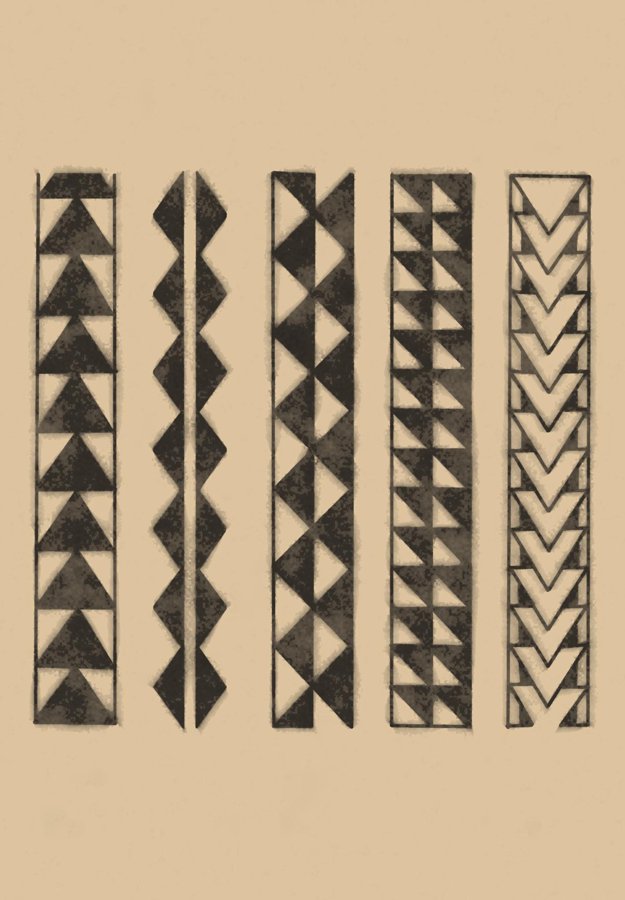
Shark Teeth
Niho Mano
Cultural Meaning
Represents strength, protection, and courage. In Hawaiian legend, a woman escaped a shark by telling him he was her aumakua. The bite left an imprint of his teeth, so Hawaiians began tattooing teeth around their ankles to signify the shark was their aumakua. The triangular rows of niho mano are among the most recognizable motifs in Polynesian tattooing, used as protective borders and foundational pattern bands.
Common Placements
Forearm bands, calf wraps, chest borders
The IslandTAT Approach
At IslandTAT, shark teeth patterns are frequently used as foundational bands that frame and protect the core narrative of a composition.
Body Placement and Its Meaning in Polynesian Culture
In Polynesian tradition, where a tattoo lives on the body is as meaningful as the motifs themselves. The body is read as a map: each zone carries its own spiritual weight and is reserved for the themes most fitting to that region.
Placement Zone
Head
Connection to ancestors, spirituality, knowledge, and wisdom.
Placement Zone
Shoulders & Upper Arms
Strength, bravery, and warrior status.
Placement Zone
Chest & Upper Trunk
Generosity, sincerity, honor, and reconciliation.
Placement Zone
Lower Trunk & Thighs
Life energy, courage, independence, and sexuality.
Placement Zone
Lower Arms & Hands
Creativity and the act of making things.
Placement Zone
Legs & Feet
Forward movement, transformation, and progress.
Traditional Tools and the Tattooing Process
At the heart of traditional Polynesian tattooing is the au — a hand-tapped tool made from a comb of sharpened bone, tortoise shell, or boar tusk lashed to a wooden handle. A second wooden mallet, the sausau, is used to strike the au rhythmically, driving pigment made from soot and water beneath the skin. The sound of the tapping — steady, ceremonial, unmistakable — is itself part of the tradition, and in Samoa it gives the practice its name: tatau.
The work is led by a tufuga tā tatau, a tattoo master whose role is part artist, part priest, part historian. Becoming a tufuga is a years-long apprenticeship, and the right to tattoo is inherited or earned within sacred lineages. During the ceremony, the tufuga is supported by stretchers who hold the skin taut, family members who sing and chant, and witnesses whose presence binds the wearer to the community. A full traditional piece — such as a Samoan pe'a — is rarely completed in a single sitting; it is a multi-day ceremony that can span a week or more, with sessions ending when the wearer can endure no further for the day.
Healing is treated with the same discipline as the tattooing itself. The wearer is bathed regularly in salt water — often the ocean — which cleanses the freshly tapped skin and is believed to carry both physical and spiritual purification. Throughout the healing weeks, the wearer is cared for by family and held to specific protocols of rest, diet, and conduct. To complete a traditional Polynesian tattoo is to pass through an ordeal that transforms the body, the wearer's standing in the community, and the wearer's relationship to ancestry itself.
Start Here
These guides are written for anyone interested in Polynesian tattoo art — from first-time clients researching their options to experienced collectors planning their next project. We recommend starting with Polynesian Tattoo Meaning and then exploring the topics most relevant to your project.
Meaning vs. Motifs vs. Symbols
These three terms are often used interchangeably, but they refer to different aspects of Polynesian tattoo design:
- Meaning — the broader themes encoded in a tattoo: genealogy, protection, journey, identity. Explore our meaning guide.
- Symbols — individual visual elements like shark teeth, turtles, and enata. See our symbol reference.
- Motifs — the compositional building blocks that combine symbols into meaningful narratives. Read understanding motifs.
Deep Dives: Polynesian Tattoo Traditions
Each major culture in the Polynesian Triangle developed its own tattoo language. Explore them in depth:
- Samoan Tattoo Tradition — the pe'a, the malu, and the unbroken tatau lineage.
- Hawaiian Tattoo Tradition — kakau, aumakua, and the asymmetric Hawaiian visual logic.
- Marquesan Tattoo Tradition — the densest, most complex Polynesian work.
- Māori Tattoo Tradition — tā moko, kirituhi, and the language of whakapapa.
IslandTAT Cultural Interpretation
The meanings, symbols, and motif descriptions presented throughout these guides reflect IslandTAT's modern, research-informed interpretation of Polynesian tattoo art. Polynesian tattooing spans distinct island traditions — including Samoan, Hawaiian, Tongan, Māori, Marquesan, Tahitian, and other Polynesian traditions — and meanings can vary significantly across cultures, regions, and family lineages. Neighbouring Pacific traditions such as CHamoru (Marianas) are Micronesian rather than Polynesian.
Motifs are inherently contextual and story-driven. The same symbol can carry different weight depending on its placement, the motifs surrounding it, and the personal narrative of the wearer. There is no single "correct" meaning for any element — only culturally informed choices made with intention and respect.
IslandTAT does not claim to be a traditional authority on any single Polynesian culture. We honor the tufuga ta tatau and the traditional masters who have preserved these art forms across generations. Our approach is contemporary studio work — informed by deep study, cultural relationships, and practice since 1999 — not a replacement for sacred cultural protocols.
We believe that mana comes from intention and co-creation — from the genuine conversation between artist and client, the respect given to tradition, and the commitment to creating work that carries real cultural and personal significance.
Meaning & Symbols
Sleeve & Design
Motif Deep Dives
Placement Guides
Process & Preparation
Cultural Traditions
Polynesian Tattoo Questions & Answers
The questions we hear most often from clients researching Polynesian tattoo art — meaning, process, pricing, and cultural respect.
Watch & Learn
Learn From TATtalk
TATtalk is our long-form podcast on Polynesian tattoo culture, hosted by Joshawa Elsas. Start with these episodes, then explore the full library.

Ready to Start Your Tattoo Journey?
Understanding Polynesian tattoo art is the first step. When you're ready to bring your vision to life, IslandTAT offers a comprehensive process that begins with a deep consultation and ends with a finished piece of culturally grounded body art.
Start with The IslandTAT Method to understand our freehand design philosophy. Then review Preparing for Your Tattoo, What to Expect During Your Session, and Aftercare Instructions.
Ready to see the work? Explore our portfolio of Polynesian sleeves, chest pieces, leg work, and back compositions. Or learn about IslandTAT and the team.