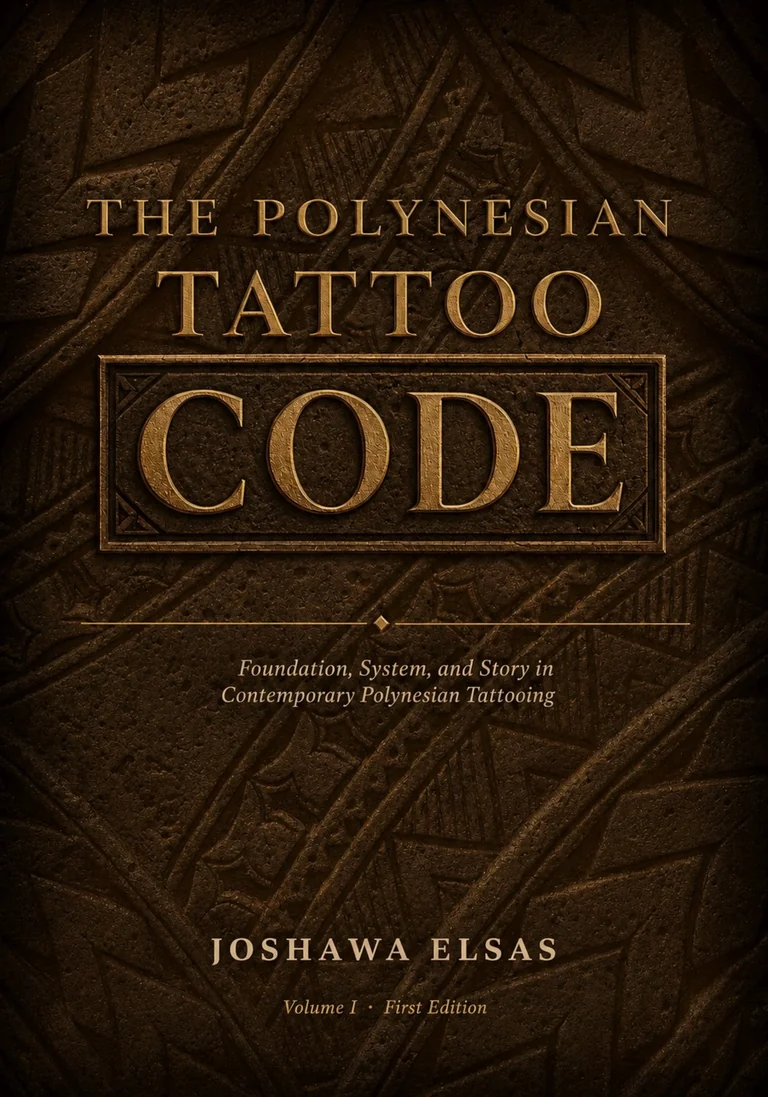
Vol. I · First Edition · By Joshawa Elsas
The Polynesian Tattoo Code
Foundation, System, and Story in Contemporary Polynesian Tattooing — a field guide to meaning, structure, and cultural integrity from the studio that has shaped freehand Polynesian tattooing in San Diego since 2007.
Written by IslandTAT founder Joshawa Elsas, this volume distills cultural study since 1999, freehand practice, and lineage-based work into the framework he uses with every client.
PDF · Paperback · Hardcover
25+
Years of Practice
273
Pages · Vol. I
11
Freehand Motif Plates
2003
Practicing Since
"Finally — a framework I can hand to a client before we even pick up the machine. This is the standard the craft was missing."
"I've had my sleeve for six years and never fully understood it. The Two-Intent Test changed how I look at my own skin."
"The MANA and TATAU sections should be required reading for anyone tattooing Polynesian work today."
A Passage from Vol. I
Read a piece before you buy the whole.
Chapter 3 · The MANA Framework — excerpt
Mana is not something you add to a tattoo by drawing more lines. It is not something a machine can deliver. Mana is the weight a piece carries because everyone at the table — the wearer, the artist, the ancestors implied by the marks — agreed on what was being built and why.
Every real Polynesian tattoo I have ever seen passes the same quiet test. The wearer can stand still in front of a stranger and, without translating a single motif, be understood as someone who is carrying something honestly. That is mana. It has almost nothing to do with pattern density and everything to do with truth.
So we start where the marks end: with the four questions. Meaning. Ancestry. Navigation. Accountability. Answer them badly and the design is decoration. Answer them well and the tattoo will be doing work for the wearer long after the healing is finished…
The Ultimate Guide
Your Ultimate Guide to Meaning, Structure, and Cultural Integrity
If you are searching for the true meaning behind Polynesian tattooing, you have likely encountered a sea of conflicting information. The internet is flooded with generic motif dictionaries, disconnected symbols, and beautiful artwork stripped of its cultural context. For anyone seeking to wear a tribal tattoo with honor, or for Polynesian tattoo artists striving to work with integrity, the questions remain: What do these marks actually mean? Do I have the right to wear them? How do I ensure my tattoo tells my real story without falsely claiming a culture?
The answers to these questions are not found in a quick Google search. They are found in The Polynesian Tattoo CODE — Vol. 1: A Field Guide to Meaning, Structure, and Cultural Integrity, written by Joshawa Elsas, founder of IslandTAT.
This page serves as the most comprehensive online summary of The Tattoo Code. It breaks down the core philosophies of the book, explains the critical difference between appropriation and appreciation, and introduces the frameworks that are changing the way modern Polynesian tattoos are designed and worn.
Whether you are preparing for your first piece, seeking to understand the ink you already carry, or looking to elevate your craft as an artist, The Tattoo Code is the required reading before the needle ever touches the skin.
The Modern Problem: The Look Traveled Faster Than the Meaning
The explosion of Polynesian tattooing in global pop culture—visible on celebrities, athletes, and influencers—has created a modern crisis. The image traveled faster than the meaning. The look traveled faster than the responsibility.
As Joshawa Elsas notes, clients often walk into studios pointing to a photo of Dwayne "The Rock" Johnson's tattoo, asking for "something like this" or simply requesting a "tribal" design. They see strength, confidence, and identity. They want to feel connected to something ancient and protective.
But a Polynesian tattoo is not a costume. It is not a generic "warrior" aesthetic. It is a highly sophisticated visual language connected to ancestry, genealogy, pain, survival, and deep cultural responsibility. When an artist sells a generic pattern as a "meaningful story," or when a wearer claims a design without understanding its roots, the tradition is hollowed out.
The Tattoo Code was written to solve this exact problem. It is not a gatekeeping manual telling you that you cannot have a tattoo. It is a compass. It provides a system to ensure that what is sold at the chair perfectly matches what is built into the skin.
The Core Frameworks of The Tattoo Code
The Tattoo Code introduces two foundational frameworks that serve as the ultimate test for any Polynesian tattoo design. If you are looking for Polynesian tattoo meanings, these frameworks are far more important than a simple dictionary of symbols.
1. The MANA Framework: The Inner Weight
Mana is a word often used but rarely understood. It is not a trend, and it cannot be added to a tattoo simply by drawing more details. Mana is inner weight, spiritual authority, and presence. It is built into a design through truth and responsibility.
The MANA framework asks four critical questions before a design is created:
- M – Meaning: Does every major mark have a real purpose, or is it just filler?
- A – Ancestry: Does the design respect the roots, the people, the specific islands (Samoa, Hawaiʻi, Marquesas, etc.), and the traditions behind the motifs?
- N – Navigation: Will this tattoo guide the wearer through their actual life story, identity, direction, and responsibility?
- A – Accountability: Can both the artist and the wearer answer for what was created and what is being carried?
2. The TATAU Standard: The Working Execution
While MANA tests the inner weight, TATAU tests the outer build. It is the working standard at the chair, ensuring the execution matches the intention.
- T – Truth: The tattoo must not be built on false meaning or fake cultural claims.
- A – Ancestry: The origins and foundations behind the motifs must be respected.
- T – Technique: The design must be built with skill, proper placement, body flow, and visual discipline.
- A – Accountability: The artist must explain the work honestly, and the wearer must carry it with humility.
- U – Understanding: The wearer must never be a stranger to the ink on their own skin.
The Two-Intent Test: A Practical Way to Judge a Tattoo
If you already have a Polynesian tattoo, The Tattoo Code offers the ultimate audit: The Two-Intent Test.
A Polynesian-inspired tattoo is not right or wrong simply because of how it looks. It is right or wrong based on whether the artist's intent and the client's intent aligned.
Did what the artist sold match what the artist actually built?
If an artist sells a piece as "Polynesian-inspired artwork with a general meaning," and builds exactly that, the tattoo is right. However, if an artist promises to weave your deeply personal life story into the motifs, but instead applies a generic, pre-drawn pattern dressed up in a fake story—the tattoo is wrong.
The Tattoo Code protects the wearer from this exact scenario. It teaches you how to audit the artist's claims and ensures that your tattoo is an honest translation of your life, not a hollow imitation of someone else's.
Blood, Water, and The Outsider-Insider
One of the most profound chapters in The Tattoo Code addresses the tension of identity. Who has the right to wear traditional Polynesian tattoos?
Joshawa Elsas writes from the unique perspective of an "outsider-insider." Born with CHamoru, Korean, and white blood, but raised in Hawaiʻi and shaped deeply by Hawaiian culture, he understands the complex intersection of genealogy and lived experience.
The Tattoo Code acknowledges that blood matters—genealogy carries heavy responsibility. But water matters, too. The culture that raises you, the community you serve, the family you marry into, and the land that shapes your heart all carry weight.
For the non-Polynesian wearer, the book offers a clear path forward: Translation, not costume. A respectful design takes your real story—your actual roots, your real struggles, your earned wisdom—and translates it through Polynesian-inspired principles of flow and structure, without ever lying about who you are or claiming an ancestry that is not yours.
Beyond the Dictionary: Why Motifs Are Not Meaning
Many people search for "Polynesian tattoo dictionary" hoping to find a simple list: Shark teeth mean protection. Spearheads mean warrior. Turtles mean family.
The Tattoo Code shatters this simplistic view. A dictionary is the starting line, not the finish line.
A list of motifs is just vocabulary. A true tattoo is a language.
- Shark Teeth (Niho Mano): Yes, they mean protection. But for a client who is nine years sober, shark teeth don't mean fighting others; they represent a hedge of self-preservation built around hard-won inner peace.
- Spearheads: Yes, they mean warrior spirit. But they also mean the quiet, daily discipline to keep moving forward through hardship.
- The Weave: Yes, it means family foundation. But for a non-Polynesian wearer from Texas, the weave honors the specific structure of a cattle ranch and parents married for fifty years.
The IslandTAT Method, detailed extensively in the book, teaches artists how to build backward—starting with the client's raw story and translating it into motifs, rather than forcing a client's story to fit a pre-drawn design.
Why You Must Read The Tattoo Code Before Your Next Tattoo
A tattoo is the only purchase you will ever make that you cannot return, cannot trade, cannot hide, and cannot forget. The time you spend before the needle is the only protection you will ever have.
If you are a wearer, The Tattoo Code will give you the exact questions you must ask your artist before you sit in the chair. It will teach you how to tell the difference between an artist who is honoring your story and one who is just selling you a look.
If you are a Polynesian tattoo artist, this book will challenge you to elevate your craft. It provides a reproducible, four-step system (The IslandTAT Method) to ensure every piece you create passes the MANA and TATAU standards. It will remind you that your skill must be governed by conviction.
What's Inside the Book?
- The Complete MANA & TATAU Frameworks: The new standard for cultural integrity in modern tattooing.
- The Heart Protocol: A step-by-step guide for wearers to uncover their true story before choosing a design.
- The IslandTAT Method: A masterclass for artists on how to consult, design, refine, and tattoo with absolute honesty.
- Motifs, Flow, and Placement: An in-depth look at how symbols change meaning based on context, and why the placement on the body (shoulder, forearm, back) dictates the narrative flow.
- Printable Studio Worksheets: Practical tools including the Pre-Tattoo Checklist, The Story Audit, and the MANA/TATAU Score Sheet.
Get Your Copy of The Polynesian Tattoo CODE — Vol. 1
The future of Polynesian tattooing will not be defined by those who blindly copy the past. It will be defined by those who understand the past well enough to move it forward with integrity.
Do not let your skin carry a story that isn't yours. Do not settle for a generic pattern when you can wear a masterpiece of truth.
"A design is something you wear. Tatau is something you carry."
Four Ways to Carry It Home
Choose Your Edition
The PDF, paperback, and hardcover are all available now. The Signature Hardcover isn't open yet — join the list and you'll be the first to know.
Digital
PDF Download
$34
The full text, searchable and portable. Instant download after checkout.
- Complete 273-page PDF
- Lifetime updates to Vol. I
- Instant delivery to your inbox
Print · Amazon
Paperback Edition
$48
The full paperback book with a QR code that unlocks every worksheet and guide as printable PDFs. Available on Amazon.
- Paperback, 273 pages
- QR code for PDF downloads
- Ships worldwide via Amazon
Inside the Book
A working framework — not a permission slip to copy designs.
“The tattoo is not the culture. It is proof that the culture was honored — or proof that it wasn't.”
Part I — The Foundation
Blood and Water, the Unbroken Thread from Lapita clay to living ink, the great traditions of one ocean and many islands, and the modern tide of ego and algorithm.
Part II — The Code
MANA and TATAU as the inner weight and the working standard. The Heart Protocol for the wearer. The Artist's Vow for the practitioner.
Part III — The IslandTAT Method
The four-step system run on every client: Consult, Design, Refine, Tattoo — translating a life into pattern that moves with the body.
Part IV — The Craft
Flow, placement, and longevity. Why motifs are not meaning. Eleven motif plates photographed from freehand work. The rate, and what you are actually paying for.
Part V — The Standard Moving Forward
The Conviction Framework — the final test before ink. The IslandTAT Principles. The standard moving forward, and who gets to build it.
The Studio Toolkit
Worksheets used inside the studio: T.A.T.A.U Pre-Tattoo Checklist, Heart Protocol, Story Audit, Design Brief, MANA · TATAU score sheet, and the Artist's Vow certificate.
Publication Details
- Project status
- Published work
- Independent source
- books.google.com
Who This Book Is For
Read it once. Then use it as a tool.
For the Client
Learn to tell the difference between a piece sold honestly and one that wasn't — and what to ask for before the needle comes on.
For the Artist
A simple system you can run on any client and get the same quality out of, every time.
For the Curious
Walk away able to look at a Polynesian tattoo and actually understand what you are seeing.
Answers